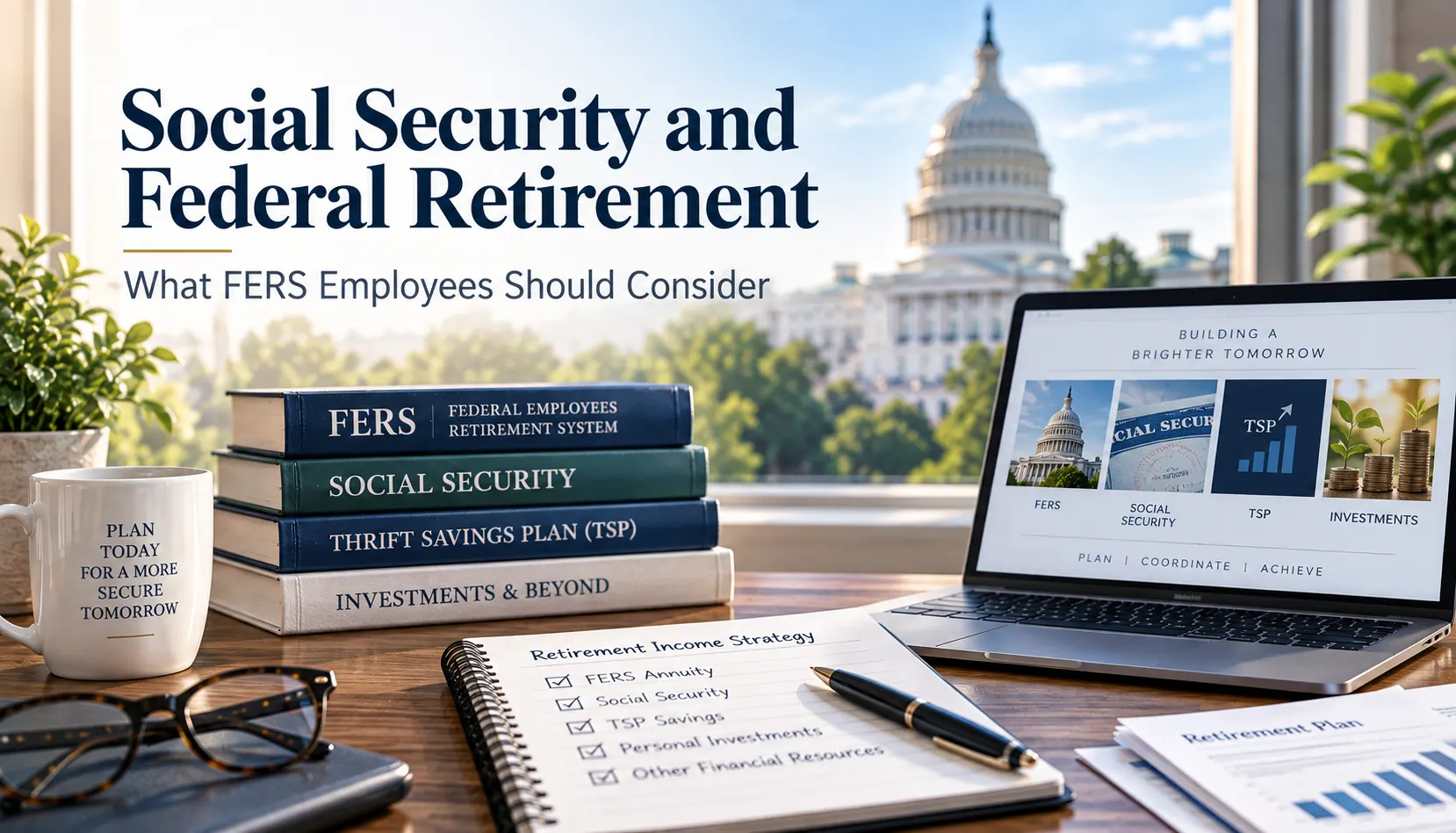


Retirement planning isn’t just about knowing how much you have saved. It’s also about understanding where your retirement income may come from, when you may receive it, and how different income sources could fit together.
For many federal employees covered by the Federal Employees Retirement System (FERS), three important components of retirement income are the FERS Basic Benefit, Social Security, and the Thrift Savings Plan (TSP).
Understanding how these benefits may work together can help you identify the questions and considerations that may be relevant to your retirement planning.
The first step may be to understand the retirement income you could receive from your FERS annuity.
Your FERS Basic Benefit can provide a monthly annuity after retirement if you meet the applicable eligibility and service requirements.
This income may provide a foundation for your retirement cash flow, but it may not cover all of your expected expenses.
Your other retirement resources may therefore also be important when evaluating your overall retirement income picture.
Your TSP works differently from your FERS annuity.
Rather than being a pension based on your federal service, the TSP is a defined contribution retirement savings plan. Your account balance can depend on factors such as contributions, agency contributions when applicable, investment performance, and withdrawals.
When evaluating your TSP as part of your retirement income picture, factors may include:
The TSP includes Traditional and Roth balances, which generally have different tax treatments. Traditional TSP contributions and withdrawals are generally subject to applicable tax rules, while qualified Roth TSP distributions can generally be tax-free when applicable requirements are satisfied.
Your circumstances can affect how these options fit into your overall retirement planning.
Social Security can provide another potential source of retirement income for eligible federal employees.
The age at which you claim Social Security can affect the amount of your monthly benefit, making the timing of benefits an important consideration for many retirees.
Rather than evaluating Social Security separately, you may want to consider it alongside:
Looking at these factors together may provide a more complete picture of your potential retirement income.
For some eligible FERS employees who retire before age 62, the FERS Special Retirement Supplement may also be relevant.
The Special Retirement Supplement is designed to provide temporary income for certain eligible FERS retirees before they become eligible for Social Security retirement benefits. Applicable eligibility requirements and earnings-test rules can affect whether and how the supplement applies.
Because retirement income can change at different ages, understanding the timing of your potential income sources can be an important part of retirement planning.
Two individuals with similar retirement income can have different after-tax outcomes depending on the sources of their income and their individual tax circumstances.
Retirement income may come from accounts and benefits that receive different tax treatment.
For example, Traditional TSP withdrawals are generally taxable, while qualified Roth TSP distributions can generally be tax-free when applicable requirements are met.
Beginning in 2026, the TSP also offers an in-plan Roth conversion option. A Roth conversion can have tax consequences because the converted amount may generally be included in taxable income, subject to applicable rules.
Tax-sensitive retirement decisions can be complex. Consider discussing your circumstances with an appropriately qualified tax professional before making decisions that could affect your tax liability.
Healthcare can be an important consideration when evaluating retirement expenses.
Federal employees should understand the requirements that may apply to continuing Federal Employees Health Benefits (FEHB) coverage into retirement.
Eligible retirees generally must satisfy applicable requirements, including requirements related to FEHB enrollment before retirement.
You may also need to consider Medicare, supplemental coverage, prescription costs, dental and vision expenses, and potential long-term care costs.
Reviewing healthcare considerations before retirement can help you better understand the expenses that may need to be included in your retirement income planning
A useful way to evaluate your retirement income is to consider each potential source and the role it may play in your overall financial picture.
Your FERS annuity may provide a predictable source of monthly retirement income if you meet applicable eligibility requirements.
Social Security may provide additional retirement income for eligible individuals. The amount and timing of benefits can depend on factors such as your earnings history and claiming age.
Your TSP and other investments may provide retirement savings that can be accessed through available withdrawal and distribution options.
Other potential resources may include IRAs, other pensions, employment income, rental income, annuities, or cash savings.
Once you understand your potential income sources, you can compare them with your expected retirement expenses and identify areas that may require further review.
Starting retirement planning earlier can give you more time to understand your benefits, identify potential gaps, and consider how your retirement resources may fit together.
Federal employees may benefit from reviewing retirement benefits, insurance requirements, TSP savings, Social Security considerations, and other financial factors well before their planned retirement date.
If you’re already within a year of retirement, reviewing these areas can still be valuable.
There is no single retirement income strategy that applies to every federal employee.
Factors that may affect your planning considerations include:
Understanding your complete financial picture can help you identify the questions you may want to discuss with qualified professionals.
Federal retirement planning can involve FERS benefits, TSP savings, Social Security, taxes, healthcare, and other sources of retirement income.
Federal Employee Advisor Network can help connect federal employees and retirees with independent, licensed financial professionals who may be familiar with federal retirement planning considerations.
The professional you are connected with can discuss your individual circumstances, goals, and available options directly with you.
FERS, TSP, and Social Security can each play different roles in retirement income planning. A FERS annuity may provide monthly retirement income, Social Security may provide additional income for eligible individuals, and TSP savings may provide additional retirement assets and withdrawal options. How these sources fit together depends on your circumstances.
Your retirement income needs depend on factors such as expected housing costs, healthcare, food, transportation, travel, taxes, insurance, family support, and other expenses. Your retirement timeline and available income sources can also affect how much savings you may need to supplement your retirement income.
There is no single claiming age that is appropriate for everyone. Factors that may be relevant include your age, other retirement income, financial needs, health and longevity considerations, spouse or survivor benefits, and overall retirement planning circumstances.
Your TSP can be one component of your retirement income plan. Available withdrawal and distribution options, your account balance, expenses, investment allocation, tax situation, and other income sources may all be relevant when evaluating how your TSP could fit into your retirement planning.
Looking at each retirement resource separately may not provide a complete picture of your potential retirement income. Considering them together can help you understand the timing and potential role of different income sources, tax considerations, expected expenses, and areas that may require additional planning.