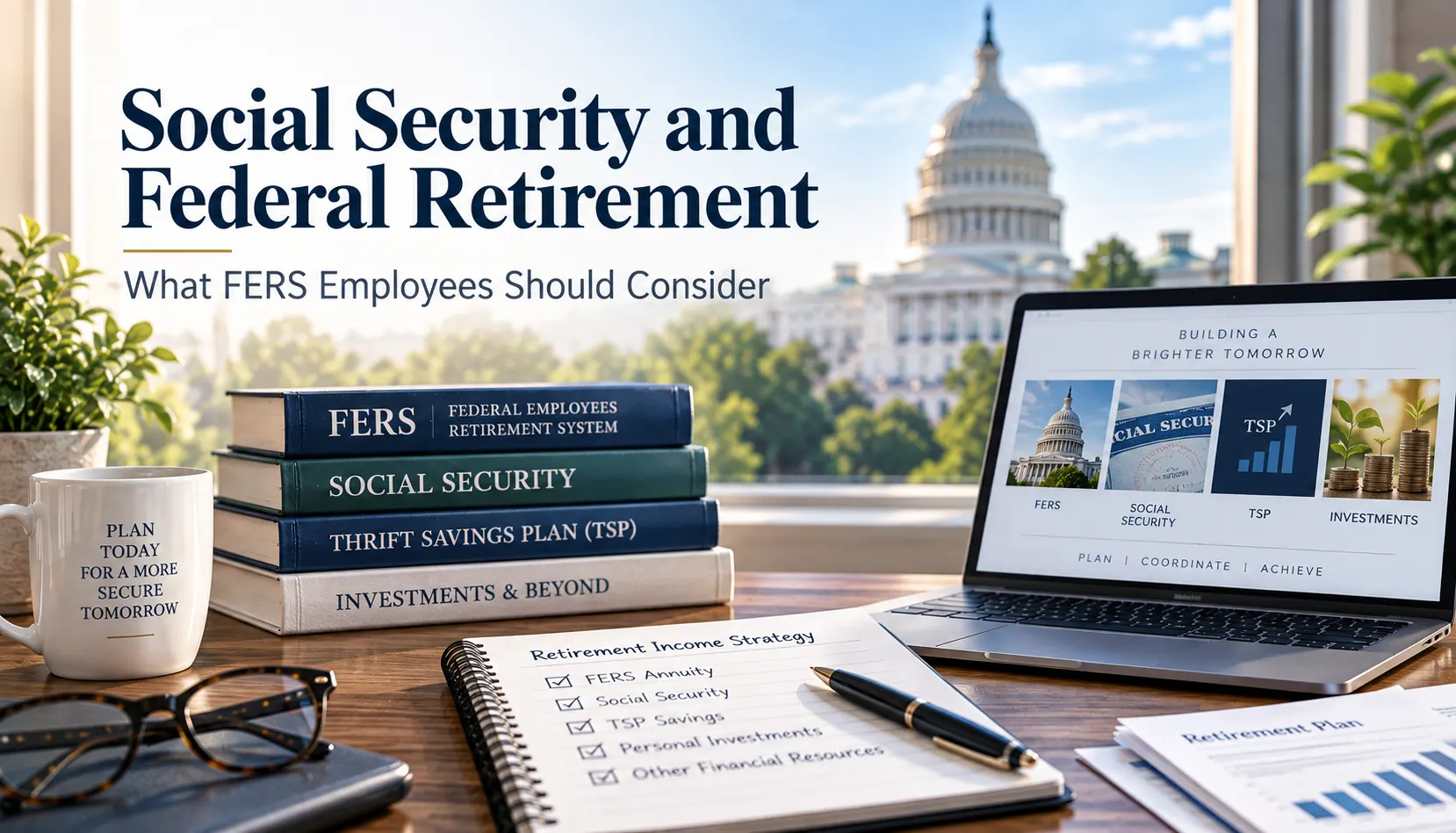

For many federal employees covered by the Federal Employees Retirement System (FERS), Social Security may be one part of their overall retirement income.
Retirement income may also include a FERS annuity, Thrift Savings Plan (TSP) savings, personal investments, and other financial resources.
Understanding how these different sources may work together can help you evaluate your options and make more informed retirement decisions based on your individual circumstances.
Yes.
Social Security is one of the three main components of FERS.
FERS generally includes:
Each component serves a different purpose within the federal retirement system.
Your FERS annuity may provide monthly retirement income if you meet applicable eligibility requirements. Social Security may provide an additional monthly benefit if you qualify, while your TSP is an individual retirement account that can be used as part of your broader retirement income strategy.
Understanding each benefit separately, as well as how they may interact, can help provide a more complete picture of your retirement resources.
Choosing when to begin Social Security retirement benefits is an important individual decision.
Social Security retirement benefits can generally begin as early as age 62 for eligible individuals. Starting before your full retirement age generally results in a lower monthly benefit. Delaying benefits beyond full retirement age can increase the monthly benefit, with delayed retirement credits stopping at age 70.
The appropriate claiming age depends on your individual circumstances and may involve factors such as:
Some individuals may decide that receiving Social Security earlier better fits their circumstances, while others may consider delaying their benefits.
Rather than considering Social Security by itself, it can be helpful to evaluate how the timing of your benefits fits within your broader retirement plan.
Social Security may represent only one portion of your retirement income. Consider how it may coordinate with the other resources available to you.
FERS Annuity
If you meet the applicable eligibility requirements, your FERS annuity may provide monthly retirement income based on factors such as your years of creditable service and high-3 average salary.
TSP and Other Investments
Your TSP and other savings or investments may provide additional financial resources during retirement. Available withdrawal choices, taxes, investment risk, and income needs should all be considered when evaluating how these assets may be used.
Social Security
If you qualify, Social Security may provide monthly retirement benefits. The amount you receive can depend on your earnings record and the age at which you begin receiving benefits.
Other Income and Resources
IRAs, other pensions, employment income, rental income, savings, and additional financial resources may also be part of your retirement picture.
Reviewing these resources together may help you better understand how your retirement income could be structured over time.
Certain eligible FERS employees who retire before age 62 may qualify for the FERS annuity supplement, sometimes referred to as the FERS Special Retirement Supplement.
The supplement is intended to provide an additional benefit to certain eligible FERS retirees before age 62.
Not every employee who retires before age 62 qualifies for the supplement. Eligibility depends on factors such as the type of retirement, age, and years of service.
The supplement may also be subject to an earnings test for certain recipients. Wages or self-employment income after retirement can affect the amount of the supplement under applicable rules.
Because eligibility requirements vary, federal employees should verify their individual situation before including the supplement in their expected retirement income.
Your TSP may be one of several resources available to help meet retirement expenses.
When evaluating when to claim Social Security, you may also want to consider:
For example, some retirees may evaluate whether other financial resources could help meet expenses during a period in which they are not yet receiving Social Security.
That does not mean delaying Social Security or using TSP assets first is appropriate for everyone.
TSP withdrawal decisions and Social Security claiming decisions can have different financial and tax consequences. Any strategy should be evaluated based on your individual financial circumstances, income needs, and long-term objectives.
Taxes may affect how much of your retirement income is ultimately available for spending.
Different sources of retirement income can have different federal tax treatment.
Distributions from a traditional TSP balance are generally subject to federal income tax when distributed. Qualified distributions from a Roth TSP balance generally receive different tax treatment under applicable federal tax rules.
Social Security benefits may also be subject to federal income tax depending on factors such as your combined income and filing status.
Tax laws and individual circumstances can change, so tax considerations should be reviewed as part of your retirement planning process.
For guidance about your personal tax situation, consider consulting a qualified tax professional.
If you’re married, retirement planning may also involve your spouse’s benefits, income, assets, and expected expenses.
Depending on your situation, consider reviewing:
Looking at your household’s overall financial picture rather than focusing on a single benefit may provide a more complete understanding of your retirement needs.
Instead of evaluating every retirement decision separately, consider looking at how your income sources and expenses may change over time.
Before Retirement
Review your FERS benefits, TSP, Social Security estimates, insurance coverage, other savings, expected expenses, and retirement eligibility.
At Retirement
Review which income sources may begin immediately and how your available resources may support your initial retirement expenses.
Before Age 62
If applicable, determine whether you may qualify for the FERS annuity supplement and understand the eligibility and earnings-test rules that may apply.
When Considering Social Security
Review the potential effect of claiming at different ages and consider how Social Security may coordinate with your FERS annuity, TSP, other assets, employment income, and household needs.
During Retirement
Continue reviewing your income needs, investments, withdrawals, taxes, healthcare expenses, and financial goals as circumstances change.
Federal retirement planning involves more than focusing on one benefit.
Your FERS annuity, Social Security, TSP, investments, taxes, insurance coverage, healthcare expenses, and other financial resources may all affect your retirement.
Reviewing these components together can help you better understand your potential retirement income and evaluate financial decisions before and during retirement.
The appropriate strategy will depend on your individual benefits, financial resources, household needs, retirement timeline, and long-term goals.
Social Security can be an important part of retirement income for many FERS employees, but it should generally be considered alongside your other retirement benefits and financial resources.
Before deciding when to claim Social Security, take time to review your estimated benefits, FERS income, TSP and other assets, expected expenses, household circumstances, and long-term financial needs.
Starting the planning process earlier may give you more time to understand the choices available to you and prepare for important retirement decisions.
FERS retirement generally includes three primary components: the FERS Basic Benefit Plan, Social Security, and TSP. If you qualify, your FERS annuity and Social Security may provide monthly benefits, while your TSP provides retirement savings that can be accessed according to applicable plan and tax rules. How these resources fit together depends on your individual circumstances.
Yes. Social Security is one of the three primary components of FERS, along with the FERS Basic Benefit Plan and Thrift Savings Plan.
There is no single claiming age that is appropriate for every federal employee. Factors such as your age, Social Security benefit estimate, FERS annuity, TSP and other assets, household expenses, spouse’s benefits, employment plans, health considerations, and financial goals may affect your decision.
The FERS annuity supplement is an additional benefit that may be available to certain eligible FERS retirees before age 62. Eligibility depends on the type of retirement and other requirements, and an earnings test may apply to certain recipients.
Eligible participants may have TSP withdrawal options available after separating from federal service, subject to applicable TSP and tax rules. Some retirees may consider their TSP as one source of income when evaluating when to claim Social Security, but whether that approach is appropriate depends on individual income needs, taxes, investments, risks, and long-term financial circumstances.
Evaluating Social Security, your FERS annuity, TSP, other assets, expenses, taxes, and household income together can provide a more complete picture of your retirement finances. This may help you make retirement decisions based on your overall circumstances rather than focusing on one benefit in isolation.